
Successfully Demonstrates 75,000-Liter Industrial Scale-Up of FermOil™ Platform Using Crude Glycerin, a Byproduct of Biodiesel Production
Demonstration campaign validates scalable production of renewable natural oil for SAF and circular bioeconomy applications

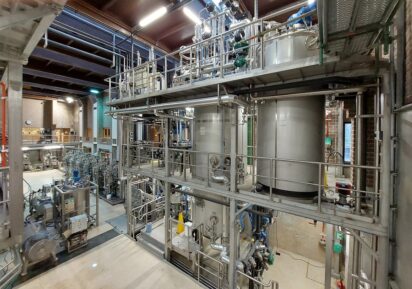
Cemvita team, Luciano Zamberlan, VP of Engineering, and Nymul Khan, Director of Technology, at Bio Base Europe Pilot Plant, next to the 75,000 L fermenter.
HOUSTON and GHENT, May 28, 2026
Cemvita today announced the successful completion of a 75,000-liter industrial fermentation campaign at Bio Base Europe Pilot Plant at industrial scale. Cemvita’s Renewable Natural Oil (RNO) was produced from industrial crude glycerin.
The campaign marks one of the most important technical milestones in the company’s history and validates the scalability of Cemvita’s biomanufacturing platform from laboratory development through industrial demonstration scale.
Over the past several years, Cemvita systematically advanced the process through multiple scale-up stages, progressing from bench-scale systems through 2-liter, 30-liter, 1,500-liter, and 15,000-liter fermentations before successfully reaching the 75,000-liter demonstration campaign.

Scale up timeline at Cemvita and in collaboration with Bio Base Europe Pilot Plant (BBEPP).
This achievement is particularly significant because most industrial bio-oil fermentation technologies have historically relied on traditional sugar-based feedstocks. In contrast, Cemvita’s platform utilizes crude glycerin, an industrial byproduct of biodiesel transesterification, converting low-value carbon residuals into high-value renewable oils. Importantly, this demonstration also materially de-risks industrial scale-up: by maintaining consistent performance across a 2,500× increase in volume, Cemvita has shown that the process is stable and predictable under industrial operating conditions.
A industry partner supplied the crude glycerin used during the campaign, demonstrating the practical integration potential of the technology within existing biodiesel infrastructure.
“The hardest part of industrial biotechnology is not proving the science in the lab, it is proving performance consistency and robustness at industrial relevant scales,” said Moji Karimi, CEO at Cemvita. “Successfully reaching 75,000 liters while achieving our set target metrics validates the robustness of the platform and our readiness for commercialization. More importantly, it demonstrates that carbon-rich effluent streams like crude glycerin can become a scalable foundation for the next generation of sustainable fuels and bio-based materials.” “Biology is becoming infrastructure.”
“This campaign showed that we had the right partner to scale FermOil™ with confidence,” said Luciano Zamberlan, VP of Engineering at Cemvita. “Across multiple vessel runs, the fermentation control strategy remained stable, and the results were consistent all the way from 30 liters to 75,000 liters. That level of reproducibility is exactly what gives us confidence as we move toward commercial deployment.”
“We are proud to support innovative companies like Cemvita in scaling breakthrough industrial biotechnology solutions,” said Hendrik Waegeman, Head of Business Operations at Bio Base Europe Pilot Plant. “Successfully operating at the 75,000-liter scale using a feedstock such as crude glycerin highlights both the maturity of the technology and the quality of the scale-up execution achieved by the Cemvita team.”
FermOil™ is designed as a Renewable Natural Oil (RNO) compatible with existing HEFA and co-processing infrastructure used to produce Sustainable Aviation Fuel (SAF) and other renewable fuels. By leveraging existing refining assets, the platform enables rapid integration into today’s energy systems without requiring entirely new downstream infrastructure.
 Crude glycerin, the feedstock used for the process, is already recognized under RED III Annex IX Part A, the advanced feedstock category increasingly prioritized by European decarbonization policy frameworks. Annex IX Part A feedstocks are expected to play a central role in the future growth of Sustainable Aviation Fuel markets as Europe accelerates the transition toward advanced waste-derived carbon sources.
The successful scale-up advances Cemvita’s broader strategy of enabling circular bioeconomy infrastructure for biodiesel producers, refiners, and industrial partners globally. Through the integration of FermWorks™ facilities, existing biodiesel plants can convert low-value crude glycerin streams into premium renewable natural oils while improving carbon efficiency and increasing value creation across the supply chain.
“This is not just a fermentation milestone,” added Karimi. “It is a blueprint for how existing industrial infrastructure can evolve into circular bioeconomy infrastructure. Every biodiesel plant generating crude glycerin is a potential platform for renewable natural oil production.
The company is currently advancing commercial deployment discussions with strategic partners across Brazil, EU, and UK.
About Cemvita
Cemvita uses synthetic biology to turn carbon waste into high-value sustainable oils and critical inputs for sectors like aviation, agriculture, personal care, and industrial manufacturing. By expanding the range of feedstocks that can be used in biomanufacturing, Cemvita is helping build a more resilient, circular bioeconomy. Learn more at https://www.cemvita.com
About FermOil™
FermOil™ is Cemvita’s renewable natural oil produced through industrial fermentation using waste carbon streams as feedstock. Designed as a drop-in feedstock compatible with existing HEFA and co-processing infrastructure, FermOil™ enables the production of Sustainable Aviation Fuel and other low-carbon fuels while supporting the transition toward circular bioeconomy systems.
About FermWorks™
FermWorks™ is Cemvita’s industrial biomanufacturing platform designed to integrate with existing energy and industrial infrastructure to convert waste carbon streams into sustainable fuels, oils, chemicals, and materials.
About Bio Base Europe Pilot Plant
Bio Base Europe Pilot Plant (Ghent, Belgium) is an independent, flexible and multi-purpose pilot facility for process development, scale-up and custom manufacturing of biobased products and processes. A wide and flexible spectrum of modular unit operations combined with the experience of our highly competent engineers and technicians enables us to translate your biobased lab protocol into a viable industrial process. Bio Base Europe Pilot Plant enables the conversion of renewable feedstocks into biochemicals, biomaterials, biofuels and other bioproducts by using technologies such as biomass pretreatment, biocatalysis, precision & biomass fermentation (up to 75,000 L), gas fermentation, green chemistry and product recovery and purification (downstream processing). www.bbeu.org.



 webdesign